



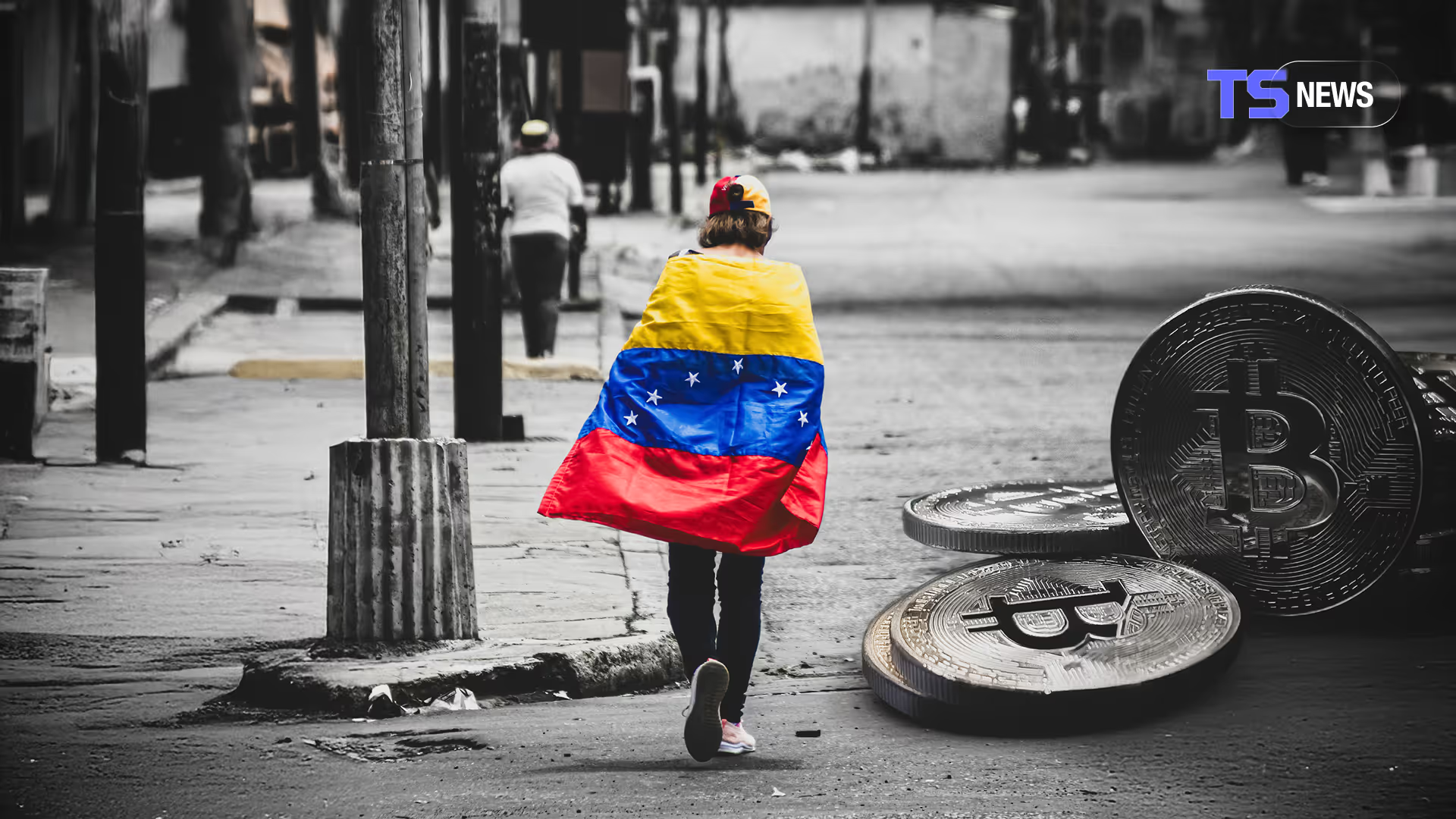
An unprecedented situation occurred where Venezuelan President Nicolas Maduro was detained in a military operation directed by US President Donald Trump[1][2]. Not only did this event completely change the political landscape in Latin America, but it has also had major ripples on the global energy map and financial markets. Attention is being paid to how Venezuela's abundant natural resources, particularly the world's largest oil reserves, which were effectively under blockade under the Maduro administration, will be utilized in the future. Furthermore, this geopolitical shock has affected crude oil prices, the stock market, and even the crypto asset market, starting with Bitcoin. In this article, we will examine the background of this historic incident, the resulting geopolitical changes surrounding Venezuela's resources, and its impact on the economy and markets from a neutral and analytical perspective.
Venezuela's Resources and Geopolitical Impacts
Venezuela has the largest confirmed crude oil reserves in the world, but production has been markedly sluggish in recent years (the figure above is a comparison between crude oil reserves and production volumes of each country as of the end of 2024)[3][4]. Estimated reserves are estimated to be around 303 billion barrels, accounting for 17 to 20% of the world's total, surpassing other major oil producing countries such as Saudi Arabia[3][5]. However, due to political turmoil, mismanagement of the national oil company PDVSA, and a decline in investment due to sanctions, production remained at only a fraction of its original capacity[6]. In fact, oil production, which had exceeded 3.5 million barrels per day in the 1970s, fell below 2 million barrels in the 2010s, and fell to about 1.1 million barrels (about 1% of global supply) last year[4][7].
With Maduro's arrest this time, the United States is in a position to strengthen its influence on this huge “sleeping” resource. President Trump professed that “the United States will lead Venezuela for the time being and will utilize huge petroleum resources to sell to other countries.”[1]It does not hide its attitude of being actively involved in Venezuela's oil concessions (Mr. Maduro himself denounces that a series of US actions are “imperialist ambitions against Venezuela's abundant oil resources”[8]). In fact, there is also a view that “the United States has effectively taken control of the largest petroleum resource in the Western Hemisphere” due to this restraint drama. Energy expert Javier Blas pointed out that “the fact that the United States effectively controlled the oil wealth of the Western Hemisphere is a geopolitical game changer,” and he also commented that it was as if it were a revival of the 21st century version of the Monroe Doctrine[9][10].
However, these resources cannot be immediately monetized. Most crude oil in Venezuela is an ultra-heavy oil that is difficult to develop, and special equipment and maintenance are required for refining and production[11]. Infrastructure has been devastated by years of lack of investment and aging equipment, and even if the United States is involved, it will take time and huge sums of money to restore production[12][13]. The Trump administration has already stated that it will “make major US energy companies invest billions of dollars and repair bankrupt oil infrastructure.”[14]We plan to discuss production expansion measures with the management teams of major oil companies such as ExxonMobil and Chevron within the week[15][16]. However, industry analysts believe that it is unlikely that companies will jump right away due to the uncertainty of the political system, the uncertainty of the legal framework, and the current crude oil price is at a relatively low level[13]. In fact, there are many prerequisites for large-scale investments in Venezuela, such as stability after a change of government or lifting of sanctions, and it has been pointed out that “cases where oil field development stabilizes early due to forced government changes are rare,” as shown by the examples of Libya and Iraq[17].
Geopolitically, major countries that supported the Maduro administration, such as China and Russia, are strongly opposed to America's bold actions. Beijing and Moscow demand that the United States release Maduro immediately[18]Protests by anti-American/pro-Maduro groups have also occurred within Venezuela[19][20]. Regional allies such as Cuba were also shocked, and it has been pointed out that there is a possibility that the current US action will spread to the geopolitical balance of Latin America as a whole. Meanwhile, the United States explained that “it is dealing with threats to its own security (narcotics terrorism and hostile administration against the United States) and does not intend to go to war with the Venezuelan people”[21]It also mentions maintaining order, such as including coordination with Mr. Delcy Rodriguez, who took office as interim president[22][23]. Either way, there is a possibility that the tug-of-war between major powers will intensify further over the course of the world's largest resource-rich countries.
Impact on the stock market and the global economy
Global financial markets initially showed a nervous reaction to this shocking news, but since then they have regained relative calm, and rather optimistic views have spread. In the US stock market, volatility rose immediately after the incident, but major indices closed at the beginning of the week were drastically high and closed[24]. The view that “geopolitical risk only provides a temporary boost” has intensified among investors, and the S&P 500 stock price index has maintained an upward trend with the strong forecast of a 15.6% increase in corporate income (profit per share of about 313 dollars) in 2026 as a tailwind[25]. Ed Yardeni of Yardeni Research said, “Geopolitical crises tend to provide stock investors with a place to buy. There will be several such phases this year.”[26]In fact, there are some voices, such as Block Bite, that this incident will provide further bullish material for the 2026 US stock market[27][28].
Energy-related stocks have benefited in particular. Since President Trump declared that he would “effectively control the Venezuelan oil industry,” stock prices of major US oil companies and related companies skyrocketed all at once. Major US oil stocks, starting with Chevron, rose across the board, and ExxonMobil and ConocoPhillips also recorded increases of 2% or more[29]. Investors are hopeful that access to “lost Venezuelan assets” will be restored and future reserves will be monetized. In fact, the US administration also suggests that “companies whose assets have been taken over by the Venezuelan government in the past cannot hope for compensation unless they return early and invest”[30][31]The recovery of multi-billion dollar compensation claims held by Exxon and Konoko has also become a reality[32]. Also, stock prices of US oil refineries (Marathon Valero, etc.) with heavy oil processing facilities also skyrocketed by 3 to 9%[33]Expectations are showing that refining margins will improve due to an increase in the supply of heavy crude oil from Latin America[34]. Furthermore, major oil field service companies (Halliburton, Schlumberger, etc.) also rose 4 to 9%[35]Then, observations of growing demand for the dormant oil well restart business surfaced.
Funds have also gone to safe assets. The price of gold temporarily soared by nearly 2% due to geopolitical uncertainty, and reached a record high of over 4,400 dollars per ounce[36]. It is a movement reflecting an emergency purchase of money, but since then it has regained calm in the form of keeping pace with stock prices. Also, in emerging markets, there was some turbulence, such as the expansion of government bond spreads in neighboring countries Colombia[37]Overall, there was limited concern that the current US military action would spread to the entire surrounding region. Colombia and Mexico, which were mentioned as targets for further intervention by the United States, also immediately denied and tried to calm down their involvement through diplomatic channels, and the market did not cause an excessive chain reaction[37]. OPEC (Organization of Petroleum Exporting Countries) also showed a calm response at an extraordinary meeting, and decided to keep production quotas unchanged at the most recent ministerial-level meeting[38]. This reflects the desire of oil producing countries to avoid market turbulence until the course of the situation in Venezuela is determined.
Overall, it can be assessed that the direct adverse effects of this event on the global economy are limited at the moment. Rather, there is also a tendency to view it as a “positive surprise” based on expectations of a drop in energy prices due to increased crude oil production and expectations for long-term stability in the South American market[39]. However, there are still uncertainties, such as intensifying tension with Russia and China, so don't make predictions. Depending on future developments, geopolitical risks will be rekindled, and there is no denying the possibility that the market will become unstable again. It can be said that the market is currently dominated by expectations for the scenario of “Venezuela reconstruction led by the United States”[40].
Impact on the crude oil market
The current coup has had a complex impact on the crude oil market. Although Venezuela is a founding member of OPEC, exports have been stagnating under sanctions in recent years. As a result, news of President Maduro's arrest did not lead to a sharp rise in crude oil prices. In fact, although the exchange rate temporarily fluctuated in trading immediately after the report, as of 1/5 at the beginning of the week, Brent crude oil futures settled at 58.32 dollars, which is only +$1 (+1.66%) per barrel = 61.76 dollars compared to the previous weekend, and WTI crude oil also settled at 58.32 dollars (+ 1.74%) of +1 dollar (+1.74%) compared to the previous weekend[41]. This is because supply from Venezuela was already thin due to US sanctions, so market participants determined that “even if exports decline due to temporary turmoil, the impact on overall global supply will be limited.”[42]. Also, the US administration has expressed a policy of “completely maintaining the crude oil embargo against Venezuela for the time being”[43]Another reason for price stability is that the ban on Venezuelan crude oil will not be lifted to the international market soon.
Rather, in the medium to long term, there is a possibility that the current coup will be a factor in lowering crude oil prices. This is because if the United States succeeds in leveraging the Venezuelan oil industry and increases production over a few years, the world's supply capacity will increase and it will be a price suppression factor[12][44]. Digital asset broker BlockByte has analyzed that “if crude oil prices fall in the future due to the exclusion of Mr. Maduro, it will be easier for capital to flow into other asset classes such as crypto assets from the energy market in 2026.”[39]. In fact, current crude oil market conditions are sluggish, with prices falling about 20% compared to 2025 due to deceleration in demand and stabilization of supply networks[45]. Currently, the WTI price is below $60, and it is a big drop from the 70-80 dollar level in the same period last year[45]. Amidst such a relatively abundant supply environment, it can be said that the improvement in the situation in Venezuela did not stir up speculative supply unease, but rather led to expectations for future supply increases[42].
However, short-term risks have not completely disappeared. If chaos persists within Venezuela, oil field equipment is damaged, and oil-producing countries (such as Iran and Russia) that are in conflict with the United States take retaliatory measures, the market will become nervous again[46][47]. President Trump is not limited to this operation and has stated that “if necessary, we will not resign from military action against other countries (Colombia and Mexico).”[37]If this is taken as a possibility of intervention in the oil-producing country Iran, the geopolitical risk could be rekindled. In fact, the Iranian government has issued a warning to the United States that it is interference in internal affairs, and market participants are also closely watching the country's exit[47]. Additionally, there is a possibility that the cohesion between OPEC plus oil producing countries will fluctuate. If the United States were to control Venezuelan oil, the country's position within OPEC would be forced to change, and there is a possibility that the coordinated production reduction system will be affected in the future.
Overall, although the crude oil market remains stable for the time being, the scenario could change drastically depending on trends in Venezuela. At this stage, we are aware of the optimistic scenario where “the Venezuelan oil industry will be rebuilt under the leadership of the United States,” so prices have settled down. However, on the other side of this, it is also necessary to keep in mind that the “backlash from other countries against the fact that the United States strengthened its control over petroleum in the Western Hemisphere” is smoldering. Crude oil is only a commodity that is inseparable from geopolitics, and there is a possibility that it will continue to fluctuate due to policy statements and changes in the international situation in the future, so market participants need to continue to carefully assess the situation.
Impact on the crypto asset market (Bitcoin, etc.)
The current Venezuelan coup drama had a ripple effect on the crypto asset market. The price of Bitcoin (BTC), which is a representative crypto asset, skyrocketed after the US military carried out operations, and temporarily recovered to the 90,000 dollar range of 1 BTC = 90,000 dollars in early January[48]. Specifically, the Bitcoin price increased rapidly due to transactions immediately after the US special forces detained Mr. Maduro, and at the beginning of the week on the 5th it rose to over 92,000 dollars and recorded the highest price level this year[48](High price level since early December last year)[49]. Regarding this movement, experts have analyzed that “the collapse of the Maduro administration does not directly become a bullish material for Bitcoin, but there are aspects where Bitcoin has increased its appeal as an evacuation destination for distributed assets and values amid geopolitical uncertainty.”[50]. In fact, analysts at Bitunix in the US pointed out that “the characteristics of bitcoins independent of central management were reviewed under geopolitical risk, and there is a possibility that demand for safe asset purchases was created,” and they believe that the current price increase was supported by Bitcoin demand as an “emergency hedge” rather[50][51]. In recent years, people have been aware of the aspect of Bitcoin as a “digital gold” that opposes concerns about inflation and depreciation in dollar value, but this time, in addition to that, the market's reflective reaction to sudden geopolitical events has been seen[52][53].
In addition, a diagram of observing a drop in crude oil prices and expected inflow of funds in the crypto asset market has also emerged. As mentioned above, the Trump administration's elimination of Mr. Maduro is viewed as a factor for future increases in crude oil production and price declines[54]. Digital asset broker BlockByte pointed out that “if energy prices fall, it will be easier for part of the investment money to go to other risk assets such as crypto assets,” and showed a bullish outlook for the 2026 crypto asset market[39]. In fact, there is also a view that the Bitcoin price came out of the lower price phase in the wake of this news, and the market price, which seemed to be stagnant, turned to an upward trend[55]. Following Bitcoin, which rose by about 1.5% in the 24 hours up to the 5th and placed in the 92,000 dollar range, Ethereum (ETH) also rose 0.9% to about 3,170 dollars, and the market as a whole became higher[56]. Also, large-scale resolution of short (price decline forecast) positions has occurred in the futures market, and data has also been reported that shorts worth 180 million dollars have been forcibly cut in the last 24 hours[57]. This indicates that investors have retracted their bearish positions and market sentiment has improved.
Situations unique to Venezuela have also had an impact on the crypto asset market. The country is known as a country with one of the highest crypto asset usage rates in the world due to hyperinflation and credit instability in the currency bolivar[58]. Even under economic sanctions, bitcoins, USDT (tether), etc. are actively traded in the private sector, and they have taken root as a means of everyday settlement and savings. There is a history where the Maduro administration itself tried to raise funds by issuing its own cryptocurrency “Petro” in the past. Due to the current political upheaval, it has also been pointed out that some citizens are buying more crypto assets as asset evacuation destinations due to anxiety about economic turmoil within Venezuela. Also, observations have surfaced that the US side freezes and seizes hidden assets (overseas accounts and cryptocurrency wallets) of those involved in the Maduro administration[59]Even in that respect, there is an aspect where demand for bitcoins, etc. that is difficult for the authorities to see has been recognized.
However, not all of them are good for the crypto asset market. Until now, Venezuela has partnered with virtual currency-friendly countries such as Russia and Iran, and has shown movements to utilize crypto assets for international remittance and sanctions evasion. If a change of government is realized, there is a possibility that such experiments on “utilization of cryptographic assets by the nation” will be temporarily stalled. There is also a view that if the financial order is reestablished under the leadership of the United States, anti-money laundering measures etc. will be strengthened, and anonymous fund flows originating from Venezuela will be narrowed down. Therefore, there are some voices that “the Venezuela-related crypto asset market will shrink in the long run,” but at the moment, Bitcoin is rather benefiting from the global financial cycle[60][61].
Overall, it can be said that the crypto asset market, starting with Bitcoin, has taken this geopolitical event as a tailwind and strengthened its upward trend. However, there is a possibility that the market will fluctuate in the future depending on how China and Russia come out, and BlockByte also warns that “there is a risk that market volatility (fluctuation) will increase due to retaliation from China and Russia.”[62]. Compared to traditional markets, crypto assets tend to have more sensitive reflexes to geopolitical news. It will be necessary to continue to keep a close eye on both the international situation and market mentality.
Conclusions: Future prospects and challenges
The shocking event of US President Maduro's arrest brought about a major turning point in the future of Venezuela and the global energy and financial situation. Geopolitically, changes have occurred in the dynamics of international politics by showing off its influence in Latin America, which the United States has regarded as its “backyard,” and taking control of abundant resources. While this works in favor of the United States from the viewpoint of resource security, there is also a risk that it will increase tension with Russia and China. On the economic side, it is taken as a stabilizing factor for crude oil prices due to expectations that the return of the world's largest oil reserves will become a new source of supply for the energy market[54]. For the time being, the crude oil market remains relatively calm, and the scenario where the stock market survives this event and remains strong is likely. When it came to the crypto asset market, it came into the limelight as a safe asset and alternative investment destination, and showed a positive response, with Bitcoin approaching the highest value range in history[49].
However, there are still many unknown elements. Future developments will vary greatly depending on political stability within Venezuela and the extent to which the new administration (Rodriguez Interim Administration) can coordinate with the United States. If security turmoil continues for a long time, not only resource development but also economic reconstruction will be delayed, and market expectations may change to disappointment. Conversely, if the transition progresses relatively smoothly and sanctions are lifted and international support is obtained, there is a possibility that the Venezuelan economy will break away from years of stagnation and return to a growth path leveraging abundant resources. As a result, the power chart of the crude oil and gas market will be rewritten, and it is also conceivable that the global energy supply structure will change.
In any case, the reality of “the current head of state being restrained by the United States” raised new questions about international politics and markets. It is a discussion about international law and the state of a sovereign nation, and at the same time it reflects the reality surrounding the allocation of global resources and security. Investors will be required to assess risks and opportunities while keeping a close eye on these trends. How Venezuela's abundant natural resources will be incorporated into the global economy in the future, and what role emerging asset classes, including Bitcoin, will play in such geopolitical changes — the 2026 world is entering a new phase.
References/Sources: Associated Press/Reuters/AFP, etc. reports on President Maduro's detention[1][8]Statistics on oil reserves and production in Venezuela[3][4], Trump administration statements and expert analysis[5][9], Investopedia, Reuters, DL News, etc. reports on market trends[40][39][49].