


In recent years, along with the development of the global digital economy, circles have attracted a great deal of attention around the world. In particular, in 2026, new ways to use the circle through collaboration with USDC and SBI will expand, and many companies and individuals have realized its convenience.
In this article, I will comprehensively explain the latest trends, from basic knowledge of circles to the structure of USDC to cutting-edge examples in the Japanese market. Please read on to see what benefits can be obtained by using circles.
Basic knowledge and structure of a circle (Circle)
Circle is a notable enterprise supporting the global digital economy. Established in 2013, Circle has been driving the development of digital currency and blockchain technology. Founder Jeremy Allaire's mission is to “realize a more open and inclusive financial system.” Circle develops services globally and has strengths in transparency and compliance with regulations compared to competitors. The growth of this circle has also contributed to improving the reliability of the industry as a whole.

What is a circle? Definition and history
The Circle was founded in 2013 in the US. The founder is Jeremy Allère, who aims to democratize finance and transfer value globally. The main products span a wide range of products, including USDC, wallets and APIs for corporations and individuals.
Circle is characterized by its emphasis on regulatory compliance and transparency compared to competitors. Our presence in the global market is also increasing year by year.
Main services provided by the club
The club is developing a variety of services.
- Issuance and management of USDC (USD coins)
- Provision of wallets for corporations and individuals
- International money transfer and settlement services
- Providing APIs and developer tools
- High security and compliance with national regulations
These services are the foundation for making global financial transactions safer and more efficient.
What is USDC?
USDC is a US dollar-linked stablecoin issued and managed by Circle. It is pegged 1:1 to the US dollar, and the issuance and amortization process is rigorously audited. USDC has a high level of transparency, and the market size is expanding from 2024 to 2026.
For more informationOverview of USDC and prospects in the Japanese marketPlease see. USDC's reliability is closely tied to the circle's ability to respond to regulations.
Partnership between Circle and SBI and expansion in the Japanese market
Circle has partnered with SBI Holdings to begin USDC distribution in the Japanese market. It complies with the regulations of the Financial Services Agency and ensures reliability. For Japanese companies and individuals, international money transfers and payments have become even more familiar by utilizing clubs.
Major domestic companies are constructing a new payment model utilizing USDC as a representative implementation example.
Circle ecosystem and partnerships
The Circle is strengthening cooperation with major global partners, financial institutions, and exchanges. The ecosystem for developers and businesses is also substantial, and community activities and events are active.
As of 2026, partnerships and new partnerships with the Web3 domain have expanded, and circles continue to stand at the cutting edge of the industry.
The latest club trends for 2026
In 2026, Circle is undergoing rapid evolution at the forefront of digital finance. The spread of USDC, collaboration with Web3 and AI, expansion in the Japanese market, adaptation to global regulations, and differentiation from competitors are attracting attention. In this chapter, I will explain in detail the overall picture of the latest trends led by circles.

The spread of stablecoins and new fields of application
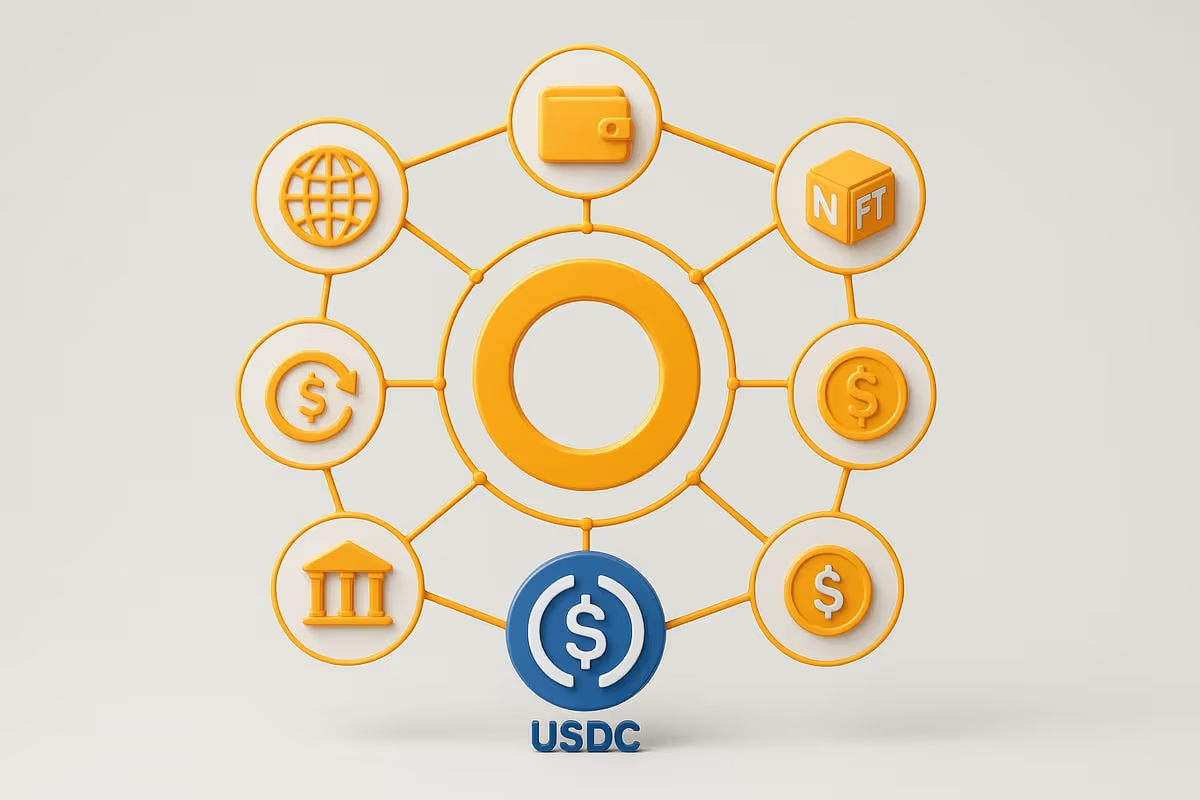
In 2026, the distribution volume of USDC issued by Circle will expand worldwide, and market share is also growing steadily. In addition to payments and remittances, the use of USDC is becoming more common in DeFi, NFTs, and gaming areas.
The use of circle services has also increased for business-to-business payments and B2B remittance. The laws and regulations of major countries have also been put in place, and the environment where it can be used with peace of mind is expanding. Compared to other stablecoins such as Tether and Dai, the circle's transparency and audit system are major strengths.
In the future, USDC will be incorporated in more diverse industries, and the circle's presence is expected to further increase.
New services based on the fusion of Web3 and AI
Circle is proceeding with integration into the Web3 ecosystem, making USDC usable for a variety of decentralized applications. Recently, the sophistication of risk management and fraud detection using AI has also progressed. Innovative services are being created one after another, such as automatic settlement with DAO and smart contracts, and provision of liquidity on decentralized exchanges (DEX).
Examples of actual projects include automated asset management that combines AI and Web3, and real-time settlement systems. For the latest industry trends,Summary of the latest AI/Web3 newsI recommend gathering information.
The growth and challenges of circles in the Japanese market
The number of USDC companies and users in the circle has also increased in Japan, and strategic cooperation with SBI is supporting market expansion. Implementation cases by major companies and improvements in convenience for individual users have progressed, and the Financial Services Agency's response to new regulations has also been evaluated.
On the other hand, there are also legal systems and cultural issues unique to Japan. Further educational activities and strengthened cooperation with companies and local governments are necessary for dissemination and expansion. As a future outlook, it is expected that clubs will be used in more diverse industries.
Circle's Global Strategy and Regulatory Response
The Circle closely monitors legal and regulatory trends in major countries, including the US, EU, and Asia, and is building a global compliance system. We are strengthening AML (anti-money laundering) and KYC to increase international reliability.
In 2026, a quick response to the new regulations is required, and the club is strengthening cooperation with the authorities of each country. As a strategy for global expansion, service expansion is underway to meet the needs of each region.
Key Competitors and Differentiators
Compared to competing stablecoins such as Tether (USDT) and Dai, Circle stands out for its transparency and audit system. Strong partnerships with major financial institutions and exchanges are also a major attraction of the circle.
It also has advantages in terms of costs and fees, and maintains a high level of user satisfaction. The table below summarizes a comparison with the main competitors.
Comparison Item Circle (USDC) Tether (USDT) Dai Transparency ◎ △ ○ Audit System ◎ △ ○ Global Expansion ◎ ◎ ○ Fee ○△ ◎The club will continue to differentiate itself and strengthen its position as a leader in digital finance.
Step Guide to Using Circles [2026 Edition]
We will introduce specific steps for using the club in line with the latest situation in 2026. In order to make the most of cooperation with USDC and SBI, let's keep track of the precautions and points at each stage.
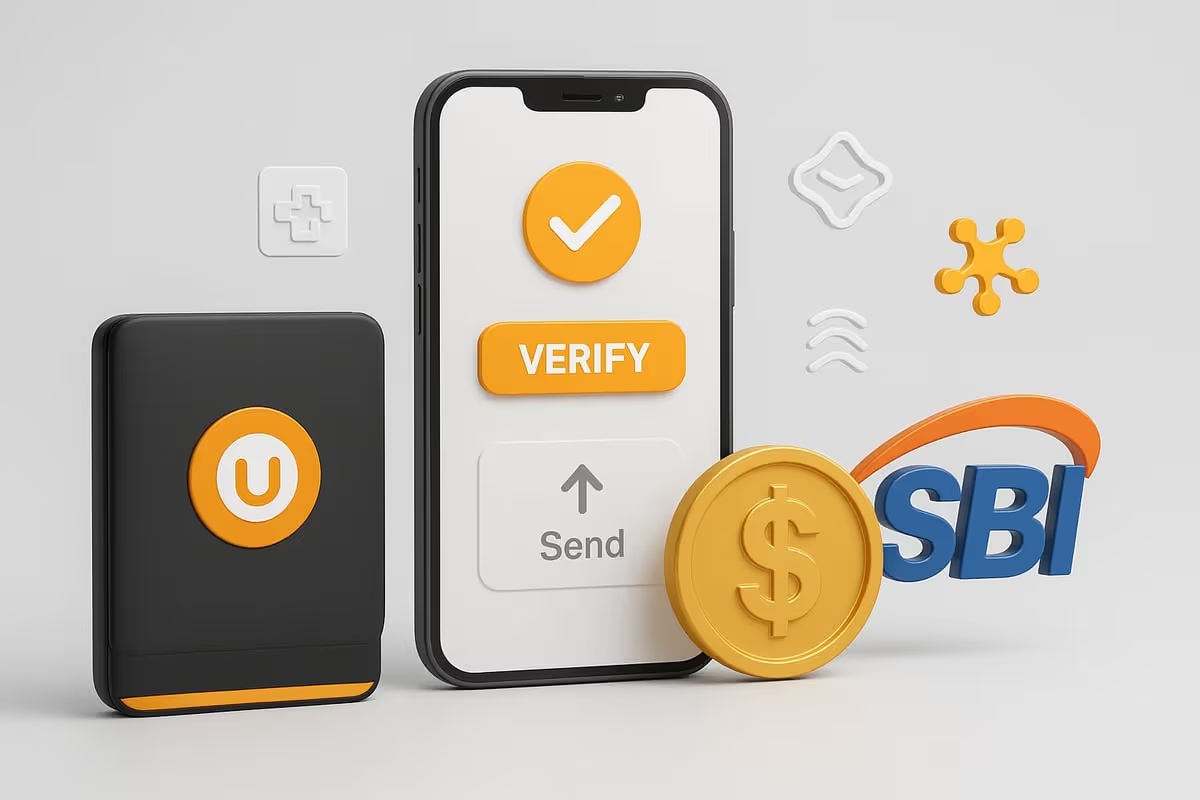
Step 1: Create an account and verify your identity
First, create an account on the club's official website or partner financial institution. At the time of registration, basic information such as name, date of birth, and address is required.
In identity verification (KYC), an identity verification document such as a driver's license or passport is uploaded. To enhance security, we also recommend setting up two-factor authentication.
Beginners should use the FAQ and support pages to clear up any questions they may have. The circle registration process is simple, but requires accurate information input.
Step 2: How to Obtain and Manage USDC
To exchange Japanese yen to USDC, use SBI and major exchanges. USDC is a stablecoin with a stable value, and is issued and managed by the Circle.
Wallets can be selected from official club wallets and partner wallets. Also check management methods and points to keep in mind when sending money.
For more information on purchasing and managing, seeCharacteristics of USDC and how to buy it in JapanIt is also helpful. Choosing safe storage methods and protecting your assets is important.
Step 3: Use USDC Remittance and Settlement
Circle's USDC can be used for transfers between individuals and businesses. The money transfer procedure is simple, just enter the other party's wallet address and specify the amount.
Fees are lower than conventional bank transfers, and the speed is also fast. Exchange risk can be suppressed even with overseas remittance, and there is a cost advantage.
Specific usage scenarios include freelance remuneration payments, B2B payments for global companies, etc. Take advantage of Circle's payment network.
Step 4: Application in DeFi/NFT/Web3
On DeFi platforms, it is possible to earn interest and provide liquidity using the circle's USDC as collateral. USDC is also used for NFT purchases and in-game payments.
Automatic payments using smart contracts have also been realized by linking with Web3 services. Decentralized exchanges (DEX) have high USDC liquidity and can be traded in a variety of ways.
Explore real project examples and new application examples to expand your circle's possibilities. If you want to know the basics of Web3, please also refer to related information.
Step 5: Responding to Taxes and Regulations
Since taxes are applied to virtual currency transactions in Japan, circle USDC transactions are also eligible. Be sure to save your transaction history and keep it organized at the end of the year.
When filing tax returns, it is necessary to accurately calculate the acquisition price and sale price. Be sure to check the Financial Services Agency's latest guidelines as well.
Laws and regulations can change every year, so please refer to the circle's official information and expert advice and respond appropriately.
Step 6: How to deal with trouble and utilize support
If you make a money transfer mistake or become a victim of fraud, contact the club's official support right away. The support desk is available 24 hours a day via email and chat.
You can also utilize support from SBI and the exchange you are using. If the problem persists, it is also effective to gather information on communities and social media.
When trouble occurs, save transaction history and evidence, and respond calmly. The circle's support system is being strengthened year by year.
Step 7: Get updates and participate in the community
Let's catch up on the latest information on the circle's official SNS and blog. Clubs and USDC-related study sessions and events are increasing in Japan as well.
In 2026, seminars on the use of circles in the Web3 and NFT fields are attracting attention. Community participation is a place for information exchange and practical learning.
By utilizing reliable sources of information and quickly grasping changes in trends and regulations, the range of circle utilization will expand.
Thorough comparison of advantages and disadvantages of using circles
When using circles, it's important to accurately grasp the advantages and disadvantages. Based on the latest case studies from 2026 and actual user experiences, we will compare the convenience and risks of circles, and success and failure cases for each usage scene.
Advantages: Convenience, Transparency, and Globality
The biggest advantage offered by the circle is its high convenience and global expansion capability. By using USDC, it is possible to make low-cost and high-speed payments and transfers 24 hours a day, 365 days a year. The high level of transparency that has been audited is also a characteristic of the circle, and users can check the safety of their assets at all times.
Advantages Item Contents Examples Convenience Can be used anytime, anywhere Transparency and reporting system Full globality USDC payments are possible worldwide Compatible with both corporations and individuals Compatible with a wide range of business-to-business payments and individual remittancesMany of the companies that have actually introduced circles have reduced the cost of international remittance and improved work efficiency. Individual users have also been praised for being able to easily send small amounts of money overseas and make Web3 payments.
Disadvantages: Regulations, Risks, Dissemination Issues
On the other hand, circles also have several disadvantages. The biggest issue is that service content may be restricted due to strengthened regulations in each country. Also, although the price of USDC is linked to the US dollar, there may be a risk of fluctuation when compared with other currencies.
The risk of cyber attacks and fraud cannot be ignored. The penetration rate is still limited in the Japanese market, and users also hear voices saying “it is difficult to use” and “the support system is uneasy.” For basic risks and types of stablecoins,Types of stablecoins and how they workIt is explained in detail in
- Risk of service outages due to regulatory effects
- Threats of cyber attacks and fraud
- Issues with penetration rates and awareness
- User fears and concerns
Actual examples and success/failure cases by usage scene
The use of circles spans a wide range of fields, from business-to-business payments to personal remittance, DeFi, and NFT fields. For example, a major company drastically reduced fees with B2B payments using Circles. Meanwhile, in individual overseas remittance cases, speed and low cost have received high praise.
- Business Settlement Implementation Case: SBI Group Global Remittance
- Personal International Money Transfer Stories: Fast USDC Remittance to Family
- Applications in the DeFi/NFT field: USDC payments in Web3 projects (see detailsWhat is Web3: Basic Explanationsee)
- Examples of failure: loss of assets due to mistakes in remittance addresses or temporary suspension of use due to regulatory changes
New circle projects will be introduced one after another in 2026, and it is expected that various application scenarios will continue to expand in the future.
Prospects for the circle after 2026 and beyond and future possibilities
From 2026 onwards, the circle will further strengthen its global presence as the fusion of finance and technology accelerates. In this section, we will explain the future image of the circle from multiple angles, from technological innovation to prospects for the Japanese market, international competitiveness, and community expansion.
Technological innovation and introduction of new services
In 2026, Circle is successively creating next-generation payment and financial services against the backdrop of the evolution of AI and blockchain technology. The sophistication of risk management and fraud detection using AI has dramatically improved safety and efficiency in the circle's USDC operation. Also, integration with Web3 is progressing, and many new services in the smart contracts and decentralized finance (DeFi) domain have appeared.
For instance,2026 AI EXPO ReportThen, the latest examples of collaboration between AI and circles are introduced, and it is expected that it will have a major impact on the financial industry as a whole in the future. Circle-led innovation is opening up new possibilities in terms of both user experience and business opportunities.
Growth scenarios in the Japanese market
Circles are also increasing their presence in the Japanese market. The use of USDC is expected to expand further due to deregulation and progress in legislation. Cooperation projects with SBI, major companies, and local governments are underway, and circle services are flexibly responding to the unique needs of Japan.
The following growth scenarios are expected in the future.
- Expansion of services under the Financial Services Agency's new guidelines
- Joint projects with local governments and educational institutions
- Cooperation with Japanese yen linked stablecoins
Due to these movements, the market size of circles in Japan will continue to expand in the future.
Strengthening competitiveness in global markets
In the global market, Circle maintains an advantage in the USDC international remittance and B2B payment fields. They are also actively expanding into emerging markets, and their unique transparency and partnership strategies are being evaluated as they compete for market share with major competitors.
Table: Comparison with Major Competitors (2026)
Item Circle Competitor A Competitor B Transparency ◎ ○△ Regulatory Compliance ◎ ○△ Number of Partners ◎ ○○The international expansion of the circle is expected to accelerate in the future.
Expanding the user and developer community
Since 2026, the Circle user and developer community has further expanded. The promotion of open source development, community-led events, and education/enlightenment activities are becoming active, and participation of diverse user groups is being promoted.
- Increase in open source projects
- Regular holding of domestic and international study sessions and seminars
- Developer hackathons and idea contests
These activities have strengthened the circle ecosystem and will continue to innovate in the future.
We've introduced the latest trends and uses of circles, and even practical steps in the Japanese market, but wouldn't you like to actually experience the cutting edge? At “TEAMZ SUMMIT” hosted by TEAMZ, you can directly interact with leaders and innovators in the Web3 and AI fields and obtain real information and networks. It's a great opportunity to advance your business and career one step further. Please take this opportunityBuy ticketsPlease join us from